
Brady Hartsfield Escalates His War
Mr. MercedesThis thread follows Brady Hartsfield from his first mass killing through his efforts to dominate and destroy K. William Hodges, culminating in a second planned mass-casualty attack.
increasing Bearing strength in each event
 decreasing
Bearing strength in each eventdecreasingThe First Massacre
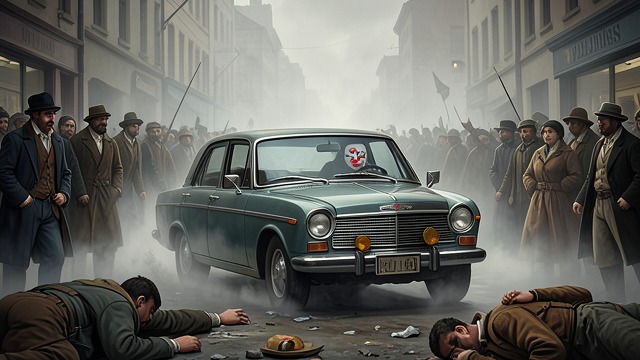
A Crime Designed for Impact
The stolen Mercedes
Brady Hartsfield steals Olivia Trelawney’s Mercedes and drives it into a packed line of job-seekers outside City Center. Fog and the crowd’s confusion make the attack difficult to prevent, and the car plows through people who have gathered overnight for a promised job fair.
The opening viewpoint follows August Odenkirk as he tries to shield Janice Cray and Patti Cray with his body. The attack kills eight people and leaves many others injured or permanently disabled. The scene establishes the scale of Brady Hartsfield’s violence while showing that its victims are individuals with lives and needs, not an abstract crowd.
Anonymity and exhilaration
Brady Hartsfield escapes, abandons the car, and leaves behind the clown mask that becomes the crime’s most memorable image. He has taken precautions to avoid identification, using a hairnet and bleach, and the fog helps him disappear before the police can establish a lead.
The killing is not presented as a conventional crime of necessity or a response to a direct grievance. Brady Hartsfield treats the attack as an exhilarating experiment and a public performance. His contempt for ordinary people and lack of remorse set the terms for the threat he will later direct at K. William Hodges.
Taunting a Retired Detective
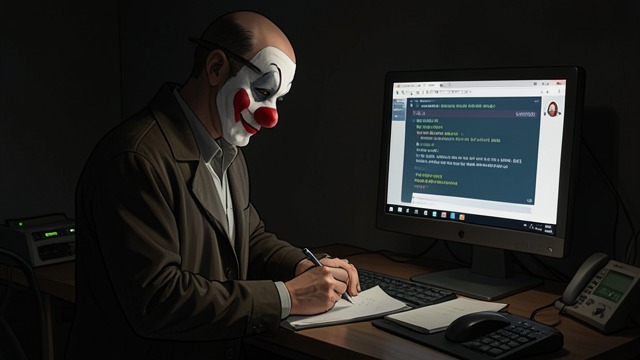
The Killer Reopens the Case
A calculated provocation
Brady Hartsfield sends K. William Hodges a letter that claims responsibility for the City Center attack and mocks the detective for failing to catch him. He writes about the violence with grotesque pride, then pivots to K. William Hodges’s loneliness and suicidal thoughts, implying that retirement has left him with nothing worth protecting.
The letter is more than a confession. Brady Hartsfield wants K. William Hodges to imagine him as an invulnerable, nearby presence and to respond emotionally. By inviting the detective to an anonymous chat site, he attempts to control the terms of their next encounter while keeping his own identity concealed.
The challenge backfires
K. William Hodges recognizes secret crime-scene details in the letter and begins investigating instead of surrendering to its taunt. He also finds the name Brady Hartsfield’s proposed online identity, merckill, and uses the chat site to answer him. Brady Hartsfield expects to manipulate a lonely retiree, but his effort supplies K. William Hodges with a path back into the case.
When K. William Hodges challenges the authenticity of the confession by referring to withheld evidence, Brady Hartsfield becomes enraged. His need for recognition overcomes the caution that protected him after the massacre. The dialogue he intended as a weapon becomes a continuing contest that draws him into revealing more about himself.
Threats Become Targeted
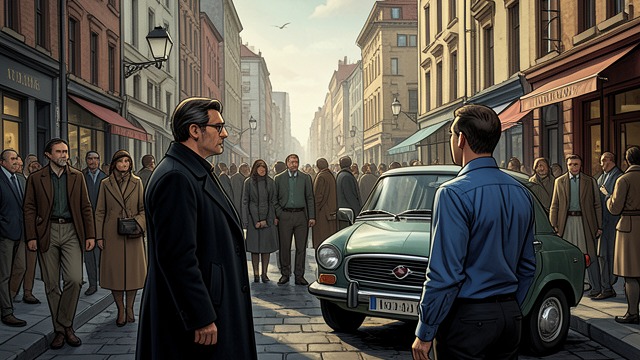
From Boast to Retaliation
The killer watches the investigator
Brady Hartsfield monitors K. William Hodges’s routines and learns about Jerome Robinson’s closeness to him. He moves through ordinary public settings as a computer technician and an ice-cream seller, using a familiar face and a familiar vehicle to remain unnoticed. In Brady Hartsfield’s mind, this concealment is part of his power: he can observe others while appearing to belong among them.
When K. William Hodges provokes him online, Brady Hartsfield considers hurting Jerome Robinson by poisoning Odell. His plan exposes the widening gap between the killer’s grand self-image and his impulsive decision-making. Before he can carry it out, his mother, Deborah Ann Hartsfield, finds the poisoned food and dies after eating it.
A personal vendetta
Brady Hartsfield interprets the accidental death as another consequence of K. William Hodges’s interference. Rather than retreat, he escalates, directing his anger toward K. William Hodges and people connected to him. He sends explicit threats through the chat site and begins treating the pursuit as a private war in which he must regain control.
The shift matters because Brady Hartsfield’s violence is no longer confined to a single past spectacle. He has become fixated on an individual opponent, and the people near that opponent are vulnerable to being used as leverage. K. William Hodges’s decision to answer the killer has transformed an old unsolved case into an immediate danger for his small circle of allies.
The Car Bomb and the New Target
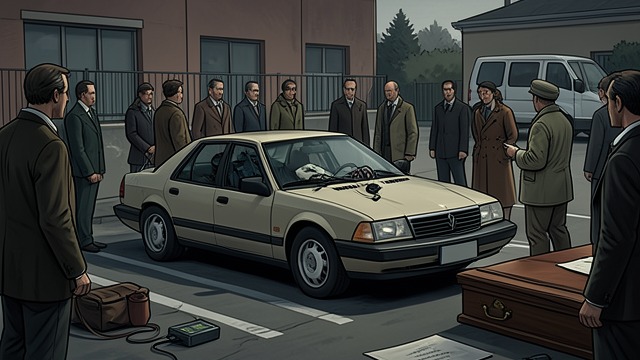
A Failed Attempt at Control
A bomb meant for K. William Hodges
Brady Hartsfield uses Thing Two to capture the keyless-entry code of K. William Hodges’s Toyota. He places a bomb inside the car while mourners attend Elizabeth Wharton’s memorial service, then waits for K. William Hodges to return and drive away. The device is intended to kill the detective and to make the attack feel like an inevitable answer to their conflict.
K. William Hodges leaves his Toyota at the last moment, allowing Janelle Patterson to drive it. The bomb explodes and kills her instead. Brady Hartsfield has successfully struck the detective’s life, but he has not killed his intended target; the violence has also destroyed someone who was helping K. William Hodges investigate him.
The consequences escape the plan
Brady Hartsfield initially believes that K. William Hodges has been killed. When the detective later sends a message from the Blue Umbrella, Brady Hartsfield realizes the attack failed and that his adversary knows more than he thought. The intended triumph becomes a fresh source of uncertainty and rage.
The bombing also reveals Brady Hartsfield’s inability to contain the consequences of his schemes. His weapon reaches an unintended victim, and the surviving investigator now has stronger grounds to identify the threat as personal. Brady Hartsfield’s effort to silence K. William Hodges instead hardens the pursuit and brings him closer to exposure.
The Second Massacre Attempt
A Larger Finale
A new audience for violence
After the car bombing, Brady Hartsfield prepares a wheelchair bomb designed to cause mass casualties at a ’Round Here concert. He initially considers carrying out a spectacular attack at the venue, imagining that the crowd’s excitement will amplify its impact. He abandons the vest arrangement and adapts the explosives to a wheelchair, seeking an appearance that will seem vulnerable and harmless.
At the concert, Brady Hartsfield blends into the crowd of young fans and uses a framed photograph to disguise the trigger beneath his clothing. K. William Hodges and his allies know an attack is possible but misread its timing and location before realizing the concert is the immediate target. Thousands of concertgoers, including Jerome Robinson’s family, are now in danger.
The trigger is stopped
Holly Gibney recognizes the risk and confronts Brady Hartsfield in the crowded auditorium. She knocks him unconscious with the Happy Slapper, while Jerome Robinson restrains his hands and helps remove the triggering device. Holly Gibney then disconnects a battery, extinguishing the warning light and preventing the bomb from detonating.
Brady Hartsfield survives but is left in a coma with minimal brain function. The crowd escapes the mass killing he planned, and his intended final spectacle never occurs. The ending defeats his desire to choose how his story will be remembered: rather than an untouchable killer’s grand finale, it becomes a failed attack stopped by people he had underestimated.
April 9–10, 2009
April 2010, six months after K. William Hodges retires
Late spring 2010, after the chat begins
June 2, 2010, after Elizabeth Wharton’s memorial service
June 3, 2010, evening at Mingo Auditorium
